Monday, 27 January 2014

Piciform Pictures

So to continue my serendipitous research in Piciformes this month, I was inspired today to do some preliminary research on the Ramphastidae (toucans). One of my most prized possessions is a whiteboard, which I've been using more and more to represent my research. I've used it on everything from ID'ing Sooty from Dusky Grouse, to working out how Pleistocene glaciation affected what are now our neotropical migrants, to this, which is the fruits of my Ramphastid research today:


Here's hoping you enjoy!

Another really cool thing I found during this morning's research is a "tree" of all bird life constructed by Jetz et al. As far as infographics go, I think this one is really beautiful:
By all means, click to zoom. This image is stunningly high resolution.

So what's next? By the end of the month, I'll have another post put together about woodpeckers with an awesome question I've been brewing for a few days now.

So keep your eyes peeled, and more importantly, stay warm!

Saturday, 25 January 2014

Don't Get Too Excited, but Syrian Woodpeckers Like Pollution

Learn about this photo at its source here.
The myriad ways that we affect our environment are pretty dumbfounding, aren't they? Just by releasing chemicals like CO2 and Methane into the atmosphere, we increase the acidity of the ocean, create a runaway greenhouse effect that elevates global temperatures, and deteriorate polar and alpine ecosystems that depend on the existence of ice. We know all this. And there are people that are doing something about it. That's all good. We'll talk about that some other time.

Another effect merely of our pollution of the atmosphere, however, that is of interest to me, is how air pollution affects trees. And all plants, for that matter. When plants, especially trees, are exposed to air pollution, and worse yet forced to grow and develop in it, things go amiss. Trees grown in air polluted areas often grow into weaker forms, with lower quality wood and disrupted processes within the tree. It would be like us trying to grow up with a constant supply of toxic gases at levels that are slightly too high to be healthy in our bloodstream. We would grow up weak and malnourished, regardless of how much food we get.

Syrian Woodpecker by Sergey Yeliseev:
http://flic.kr/p/66rnF2
Now apply this back to trees. In cities, many trees receive plenty of good soil, fertilizers, access to sunlight, and watering from caring gardeners. But with the addition of air pollution, however, something will always be slightly off for the tree. And often, this "slightly-off-ness" manifests itself in a reduction of natural defenses from parasites and insects living within the tree, to the tree's detriment. In its slightly weaker form, polluted trees are worse off at defending themselves from, for our purposes, insects.

If you were wondering when birds come in (because they have to here, right?), we're there. Woodpeckers, specifically Syrian Woodpeckers (Dendrocopos syriacus), were studied around Krakow, Poland, to see how their numbers relate to thirteen urbanized habitats and the amount of pollution in those areas. Because of the air pollution in the study area, trees had reduced defenses and thus harbored more insect life. And all pollution aside, that means food for the Woodpeckers. The study found that:


The number of trees, coverage of woody vegetation, total vegetation cover and level of pollutant emissions were significantly higher in Syrian Woodpecker breeding territories than in the random points. 

 So, counterintuitively, it was found that habitats often thought of as negatively correlated to bird numbers hold a hidden twist...a bit of an incongruity. The pollution of urbanized habitats indirectly holds benefits for insectivorous wood-clinging birds; weaker trees equal higher susceptibility to insect infestation, and that equals a buffet for woodpeckers.

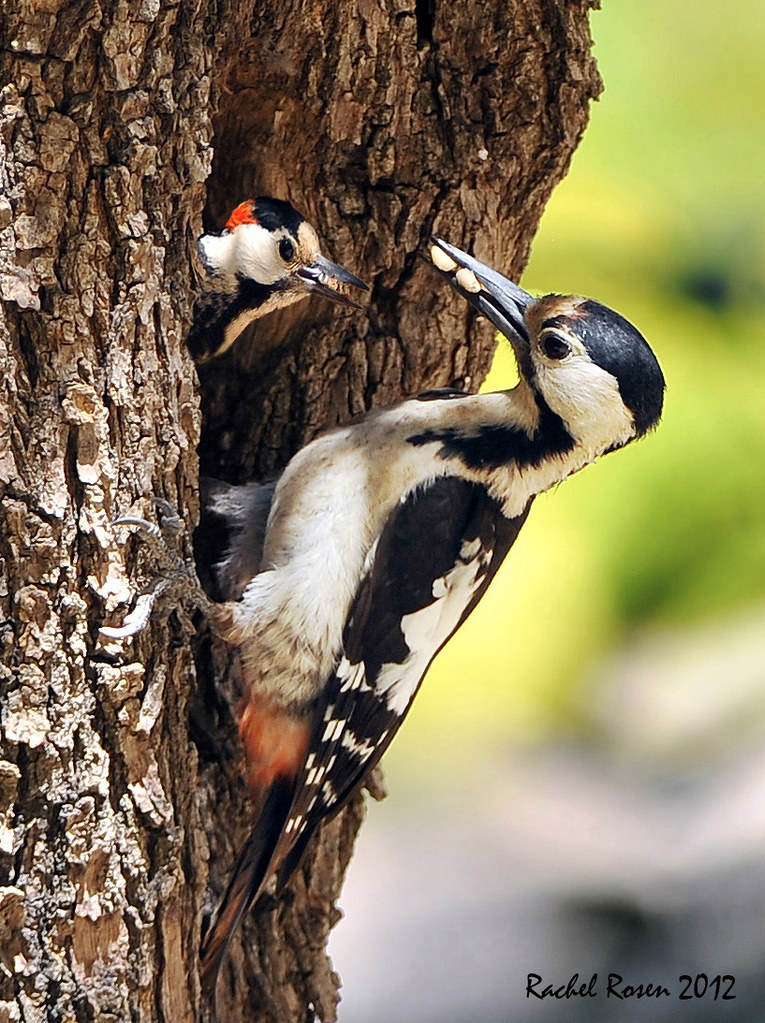
Photo by Rachel Rosen:
http://flic.kr/p/dbaqZA
But this is not a case where we should leap up in victorious arms and yell, "Yes! City's aren't that bad for wildlife!" The effects of atmospheric pollutants still take place on the birds, and more significantly, affect their breeding cycles. We can't negate all the research throughout the years that have exposed the negative effects of urban environments on their avian inhabitants.

In this case, we have what is called an Ecological Trap. Animals, when selecting habitats to live in take in a variety of environmental cues. Quantity of food, cover/shelter, and density of other animals of that same species are some of these cues. In an ecological trap, one or more of these cues appear to be higher in quality to the selector, while others are coincidentally far worse. A good analogy would be selecting a home in a dirty, overcrowded, crime-ridden neighborhood just because it's near a world-renowned yet inexpensive restaurant. Woodpecker foodies are selecting dirty and overcrowded urban environments because they're full of easy-to-access food in decrepit trees. They have been ecologically "trapped".

While we have, in our various human doings, provided a reliable and predictable food source for woodpeckers, we have also created in them a habit of sacrificing the quality of their home for this food source. Now exposed directly to the pollutants of the city, Syrian Woodpeckers and their young are subject to the many detrimental effects thereof.

So what may seem at first to be a hidden positive of existing in the city actually reveals itself to be our confusing of the natural tendencies of the Syrian Woodpecker.

Fascinating, and not a little bit worrying.

- - - - - - - - - - - - - - - - - - - - - - - - - - - - - - - - - - - - - - - - - - - - - - - - - - - - - - - - - - - - - - - - - - - - - - - -

Ciach, Michał, and Arkadiusz Fröhlich. "Habitat Preferences of the Syrian Woodpecker Dendrocopos syriacus in Urban Environments: An Ambiguous Effect of Pollution."Taylor and Francis. Bird Study, 24 Oct. 2013. Web. 25 Jan. 2014. <http://www.tandfonline.com/doi/abs/10.1080/00063657.2013.847899#.Um4yvxZy_8s>.

Wednesday, 15 January 2014

Woodpeckers Tie Continents Together

Let me weave you a couple of yarns...

Photo by Alan Prather
http://flic.kr/p/6dCgeh

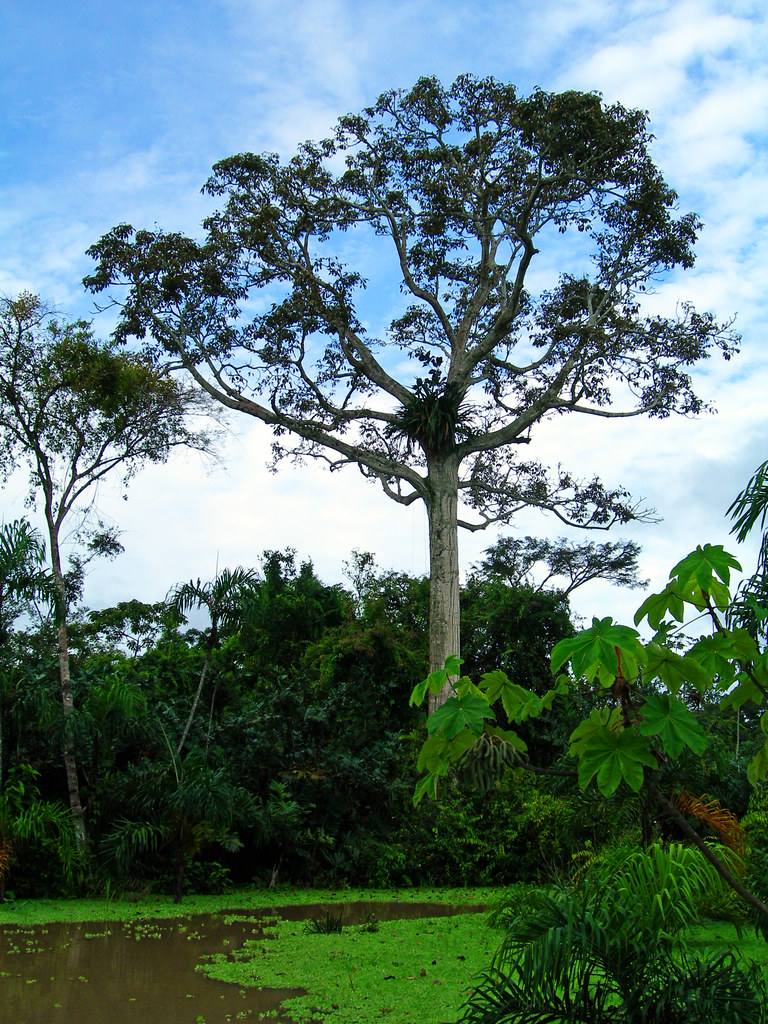
The forest hisses with a cacophony of crickets and frogs, echoing in the ventriloquy of the mist. Light beams of the early morning peer in distinct beams through holes in the vine-strangled foliage, and as the sun rises, and the mist clears, the damp forest cycles through the multiple choruses of birdsong. But below the high squeals and sharp whistles of passerines, reverberates a low tapping, like some unseen snare-drummer living among the orchids and bromeliads. Piercing through the extended growl of Howler Monkeys and clucks of toucans, the drumming continues in crescendo, until finally, with powerful wingbeats, the culprit swoops upward onto the vertical surface of Brazil Nut Tree. Its elongate shape, stiff tail working with the legs to form a clinging tripod on the tree trunk, and large size identify it as a woodpecker in the genus Campephilus.


Photo by Ross Websdale
http://flic.kr/p/GTNCw
The woods chirp and croak with a myriad of insect and amphibian life, whose sounds bounce off various wet and waxy surfaces. In the early morning, amber bars of light illuminate the fog, and as dawn evolves into day, diverse groups of birds come together to sing and court. And beneath the shrill tones of bird and bug rings the thrashing sound of a drum, like a distant helicopter mumbling violently through the dipterocarps and Tualangs. Bursting through the cracking sound of elephants on the move or the clucks and phrases of Gibbons in the canopy, the drilling goes on, progressively louder and louder, until its staccato beats exist right above you. And at last, the woodland percussionist makes its appearance as it dives in midair to the 90° trunk of a durian tree. Its slim build, rigid tail functioning as a third leg for pivoting on vertical substrates, and great size identify it as a woodpecker in the genus Blythipicus.

Forests are a fantastic example of a living environment, an
ecosystem of taxa coevolving unendingly.
Photo by § ßΘΘ⊂нє⊂к: http://flic.kr/p/hckASi
Evolution has a funny way of interconnecting our world, of bringing completely different geographical areas with completely different evolutionary histories together, and in fantastic ways. Life is united in an ever changing process of improvement and adaptation. The key part of this process to understand, for us at least, is that it does not only depend on the environment itself. Before we get to woodpeckers, we must understand how the environment is influenced by life.

Our environment, at a global scale, exists as it does today solely because of life. Biological processes have utterly and permanently modified earth's atmosphere via the water cycle and photosynthesis. They have altered Earth's geology by changing the chemistry of rocks and altering soils. Life, in a way, is our environment. We have life to thank for everything from the O₂ that we breathe to the soil that we farm on. Without the mark of life on our pale blue dot, Earth would be a cold and desolate wasteland not unlike that of a geologically active Mars.

So because of this wonderful and beautiful process, we can never really talk about species adapting to solely their environment. The environment, when taken alone without life, is static and unchanging. But we know that evolution does not stop...it never quite gets there. That's because in truth, life is adapting to all the life around it: any individual organism is adapting to its ecosystem--the collection of all living things and the nonliving environment they influence--which is also everchanging. In an ecosystem, the only constant is change. The interconnectivity of life in an area is truly dumbfounding, and often underappreciated.

Now that we've established this, let's return to woodpeckers. When you get two areas, no matter how widely separated, whose ecosystems move in similar directions, like the rainforests of Amazonia and of Southeast Asia, you get a fascinating phenomenon known as convergent evolution. Species that occupy similar niches (roles) in the ecosystem tend to adapt in similar ways. Though fascinating, this is not the case with woodpeckers, though it may, at first, seem like it. (Bear with me...I know I can be a bit tangential, but the points that led up to this were too good to leave out). With Woodpeckers, instead of convergent evolution accounting for their similarity between continents, common ancestry does.

Figure 2 of the study by Benz et al. that inspired this post. This figure
does an awesome job of showing the divided distribution of different
branches of the woodpecker tree of life (phylogeny). Click to enlarge,
Through all the millions of years of the adaptation of rainforest, woodpeckers have remained remarkably similar, occupying their same niches in the ecosystem. While ecosystems, species, and even continents have diverged and drifted apart, woodpeckers, with common ancestry between a set of subfamilies, tribes, or even genera across the earth, have remained similar enough for us to identify how the continents have split them up. Groups of genera show how different groups of woodpeckers diverge with the continents. Piculets--small, woodpecker-like birds without the stiff tails seen in other woodpeckers: subfamily Picumninae--exist in the New World as Picumnus, and in the Old World as Sasia. Large woodpeckers, like the ones described above--tribe: Megapicini, literally "giant woodpeckers"--exist in the New World as Campephilus and in the Old World as Blythipicus, Reinwardtipicus, and Chrysocolaptes. A tribe called the Dendropicini which contains familiar species like Red-bellied Woodpecker, Yellow-bellied Sapsucker, and Great Spotted Woodpecker, exist in the New World as Melenerpes, Veniliornis, and Sphyripicus, in the Old World as Dendrocopos, and in both as Picoides.


The genera here, for our purposes at least, are not important. What's important is that when we look at
The family tree (phylogeny) of woodpeckers, as
constructed by the study cited below. Click to enlarge.
the family tree, the phylogeny, of woodpeckers, we see that in each branch of genera and species, there is a division right down the middle. One side exists in the New World, and the other exists in the Old World. And unlike many species that exist like this because of convergent evolution, woodpeckers exist in this way because of common ancestry. Woodpeckers, through their evolutionary history, literally tie continents back together. In one family of birds (Picidae), entire biomes on separate continents are united at a global scale. What could be further apart than Brazilian rainforest and jungles in Thailand, than North American Boreal forest and the Congo, than Carribean woodland and Indonesian parkland? The only thing that divides woodpeckers is the continents, and, conversely, woodpeckers are also one of the many fascinating things that tie them back together.

The power of DNA analysis techniques is truly mindblowing. They have, in this case, told a story of continental unity, of global interconnectivity, once hidden in the nucleic acids of the woodpeckers.

Science is not just numbers and datasets. It's about the stories of life; all its triumphs, extinctions, and adaptations. It's about discovering new perspectives on our own lives as revealed by the world around us. The woodpeckers, through ornithology, teach us that we are citizens of the earth rather than whatever political region we’ve ended up in, and in many ways that aren't immediately obvious, we are interconnected. And knowing this may be as simple as looking at the little chemicals in our cells.

Isn't that cool?!

- - - - - - - - - - - - - - - - - - - - - - - - - - - - - - - - - - - - - - - - - - - - - - - - - - - - - - - - - - - - - - - - - - - - - - - - - -

Postscript:

As part of my research for this post and just because of general interest, I visited the Field Museum of Natural History's Bird Collection recently to trace out woodpecker phylogeny. The Field Museum (hereafter FMNH) bird collection is the third largest in the united states and contains over 500, 000 specimens, representing ~90% of the world's birds. The picture quality as far as colors go didn't turn out too great here, but pay more attention to structural similarities within these groups. Here's some of what I found:

These are a few specimens to represent the woodpeckers within the tribe Megapicini on which genetic work was done
by Benz et al. From Left to Right, we have Campephilus guatamalensis (Pale-billed Woodpecker) and Campephilus rubricollis (Red-necked Woodpecker) of the New World, and Reinwardtipicus validus (Orange-backed Woodpecker), Blythipicus pyrrhotis (Bay Woodpecker), and Blythipicus rubiginosus (Maroon Woodpecker) of the Old World.
This is a branch (taxonomists term this a "clade"...I'll be calling it that from here on out) of species/genera within the tribe Malarpicini. From left to right we have Piculus chrysochloros (Golden-green Woodpecker), Colaptes melanochloros (Green-barred Woodpecker), Piculus rubiginosus (Golden-olive Woodpecker), and Colaptes auratus (the ubiquitous North American Northern Flicker) of the New World, and Celeus loricatus (Cinnamon Woodpecker) and Celeus flavescens (Blond-crested Woodpecker) of the Old World. If you take a gander at the phylogenetic tree above--the last image in the actual blog post--you can see this branch second from the top within Malarpicini. You can also see that according to this study, a reorganization of the genera in this clade may be in order.

This last image I'll share is a set of specimens from the tribe Dendropicini, which means "tree woodpeckers". Not sure who decided on that. Anywho, from left to right, we have Melenerpes striatus (Hispaniolan Woodpecker), Melenerpes aurifrons (Golden-fronted Woodpecker), and Sphyrapicus varius (Yellow-bellied Sapsucker) of the New World, and Dendropicos goertae (Grey Woodpecker), Veniliornis fumigatus (Smoky-brown Woodpecker), and Veniliornis kirkii (Red-rumped Woodpecker) of the Old World.
- - - - - - - - - - - - - - - - - - - - - - - - - - - - - - - - - - - - - - - - - - - - - - - - - - - - - - - - - - - - - - - - - - - - - - - - - -

Works cited:

Benz, Brett W., Mark B. Robbins, and A. T. Peterson. "Evolutionary History of Woodpeckers and Allies (Aves: Picidae): Placing Key Taxa on the Phylogenetic Tree." Molecular Phylogenetics and Evolution 40.2 (2006): 389-99. Print.

View/download the entire paper here: darwin.biology.utah.edu/china/PDFs/TaxaBirds4.pdf‎