Saturday, 19 October 2013

My Summer in One Big, Inspiring Nutshell

My hand with Harpy Eagle talons
Ever since I was a tiny, human thing at the age of three, my imagination has been launching me into ornithology. As a toddler, I would wake up in the morning and invent a new bird to draw. As a 5th Grader, I would get home from school and pour through the same pages about birds of prey in my favorite field guide. As a 13-year old Middle-Schooler, I would finish homework and dinner in the evening and then drill myself with gull identification. Well guess what? I still have that childish imagination, still vaulting me into my passion and my future. Now, it's all about the act of being an ornithologist. I dream of waking up at insane hours to go and do field studies. I dream of nights up late analyzing DNA. I dream of days spent in isolation trying to figure out some variable in an experiment. I dream of meals spent with so much discussion of findings that I forget to eat. To put it simply, I really really want to be an ornithologist. But this summer, a got a bigger taste of it than I could have dreamed of. This summer, my dreams became real, more of a tangible path than some abstract aspiration.

Looking into part of the bird collection in all its vast splendor
I began my summer away from school at the Field Museum, interning there with some variation of 9 to 5 on weekdays. This was the ultimate experience of being in a scientific institution, and the thing that shocked me most was the people. Things were casual. Scientists are paid to think and to share ideas, and part of that is just, well, talking. And trust me, I'm good at that. I picked the brains of almost everybody in the Bird Division there, especially the curators. And in retrospect, the resources, all the available knowledge, though humbling to some, are like golden opportunities for curious people like myself. It's that kind of access to knowledge that will keep me coming back for years, maybe a lifetime.

Spangled Cotingas in the collection
I went on to teach about nature at Makajawan Scout Reservation for month after that. This wasn't so much an ornithological pursuit per se, but it ended up being a culmination of what I learned at the Field Museum: passion in learning for learning's sake. Discovery because it's cool. Investigation because it's fun. Flexing your brain is a process involving amazing people, mind-boggling resources and technologies, and it puts you in a powerful position: through science, you have the ability to learn things that have never been learned before...to know things, to understand things, totally and utterly novel to humanity. Why this passion isn't taught in science classes, I don't understand. Kids need to know why we do science in order to be inspired to be scientists.

The bog at Makajawan Scout Res. Photo by Austin Coolidge
This is where my teaching at Makajawan comes into play. In Bird Study, I taught kids about how you can go into the forest, and find something that has never been seen in that place before. In Oceanography, we learned that 66% of the planet--unexplored areas of the ocean--have never been seen by human eyes...something kids looking discover new stuff in the future get really into. In Fish & Wildlife Management, I emphasized that knowing as much as you can about topics relevant to your problem make you a really good problem-solver, and that's awesome. It all came together. And though my ultimate goal at Makajawan was to instill passion for discovery in the kids, I think the most profound effects were within myself...all from a few weeks interning in the Field Museum. I understand more clearly my mission in life, and I'm really lucky to have that kind of insight.

My mission was further focused at the 2013 AOU/COS Meeting, conveniently in Chicago. The Illinois Young Birder's Club graciously sponsored me fully to go to a day of the conference, and my goodness was it glorious. Hundreds of smart people were all over the place, discussing research, crazy experiences abroad, or funny stories of experimental screw-ups over coffee, a scientific necessity.
Presentation from one of the plenaries

And oh, all the research. After the fascinating plenaries to start the day, a stream of 15-minute talks, grouped by subject, in various places around the Palmer House took off. Though interspersed with breaks here and there, the day was one of constant brain expansion. Evolutionary biology, parasitism, rainforest ecology, methods in conservation, migration science, breeding ethology, systematics, etc etc etc. It was all there.

And all the talks were given in the format of research articles, which helped to outline scientific organization of information for me. It all came together to show how much there is to ornithology. There's so much more than keeping track of taxonomy or the latest ID tricks...every bird has many layers of fascinating biology, even ones like House Sparrow. There's so much to learn about every bird, how it interacts with the world, and its interaction with other species. And ultimately, it contributes more and more to our overall understanding of our world, every...little...but. Every bit of learning and discovery you do, even casual birding is important, is worthwhile, and is awesome. And everyone at this conference seemed to believe this with as much conviction as I did.

So from a personal level, beyond being fun and productive, my summer was something I'll be drawing off of for years, In the long-run, it helped me come to understand what I value, who I want to be, and what I want to share with other people. And it gave me more momentum, more ambition, moving into my future. So it looks like that childlike imagination I've had since I was a toddler might be something a little more far-seeing. Maybe it wasn't so childish. We could even call it foresight. And that...well...that's a pretty cool thing to discover.

Wednesday, 28 August 2013

What Makes Fall Migration So Weird?

The best part about Fall Migration is that it's totally not a Fall migration. The beginning of it comes bit by bit in mid-June, when failed breeding shorebirds and some songbirds show slight influxes. Amazingly, this happens as Spring Migration is just wrapping up.

Note the Fall peaks of these shorebird migrations. Data
from eBird
"Fall" Migration continues at a slow pace until mid-July, when things start picking up. With summer drying up lakes, ponds, and rivers into mudflats, we see shorebirds moving en masse southward. This has been the bulk of Illinois' "Fall" Migration so far. Birds like Semipalmated and Least Sandpiper, Semipalmated Plover, Lesser and Greater Yellowlegs, Short-billed Dowitcher, Solitary Sandpiper, and more have been coming south from their tundra or taiga breeding grounds since the end of their tiny window of breeding opportunity. And they, along with some vagrant relatives from Eurasia, have been the ones stealing the show in all their gray-brown splendor. These charadriiforms are peaking in their migration RIGHT NOW, and places like Chautauqua, the Lake Michigan shoreline, and various spots with the right conditions have certainly seen it, and the invertebrates that live there certainly have too.

But with the coming and going of peak shorebird migration, we first watch the post-breeding dispersal of songbirds and then, eventually, their southbound migration. As August hit its mid-point and began to wane, songbirds really started moving with a purpose, albeit not quite at peak levels...yet. Right now, we are at an epic transition period--in September, we will watch growing numbers of warblers, flycatchers, thrushes, vireos, and sparrows, many have whom have never migrated before, as they use our humble abodes as stopovers. As clocks in their heads tick away, as magnetite particles in their bills vibrate to the earth's magnetic field, as hormones rush in their veins telling them to push on, we will again be witness to one of nature's greatest phenomena.

Gradually, flycatchers, warblers, and various other passerine groups are making a showing in the prairie state, and some places have gotten fairly good species counts. If you're out birding now, you may be seeing Swainson's Thrushes, Veeries, Tennessee, Nashville, Magnolia, Chestnut-sided, Black-throated Green, Black-throated Blue, and Wilson’s Warblers, American Redstarts, and any early migrants from the Emberizidae, Cardinalidae, or Icteridae. Only expect these numbers to increase. And not just numbers of individual birds. Numbers of species too. This number will at least double before the end of September. And we never know what may show up in your neck of the woods...

Speaking now from personal experience, it seems that Spring Migration is much easier to tack a beginning and end onto than Fall Migration. My explanation for this is that in spring, birds are motivated northward by the will to breed, whereas in the fall, birds are motivated by survival. With fairly good consistency (see courtship rituals of almost any large mammal), survival, though important, doesn't motivate the sense of urgency that reproduction does. And we see just that in Spring Migration; birds seem to have a much greater sense of urgency to establish territories and mate, which all species will attempt to do. In Fall Migration, sometimes being early does give an advantage to those flying south to the nonbreeding grounds, but generally a set social hierarchy defines this regardless. Some species aren't even territorial on the breeding grounds. Some shorebirds never even make it to the final nonbreeding ground, and instead just stay over at some productive stopover site. And what about seabirds, who essentially just wander for food until the urgency of finding a territory and a mate returns in the Spring?

Understanding this we get to one of the best parts of "Fall" Migration from a birding perspective: vagrancy. Without this sense of urgency, as well as a huge crop of inexperienced new migrants, we get more individuals wandering brain-exploding-ly far off their typical migratory path, which makes vagrancy more frequent in the Fall. Some other migrants have elliptical migratory paths, where they take one path to the breeding grounds, and another--one closer to us--on the way back south. Overall, this beautiful chaos will take us all the way into winter, when we will arbitrarily decide that migration is over.

The line at the end of Fall migration--found somewhere in Mid-December--is as blurry as the beginning. Winter birding is characterized by many nomadic species, forced to be highly mobile by thin distribution of food in colder months. But this also is a cause of easy confusion, as migration southward turns into just plain wandering. Overall, this enigma that we call "Fall" Migration teaches us one thing (of many): though terms like Spring and Fall Migration are useful, they never really end, so to speak. Migration happens at the level of an individual bird, and that bird can be completely on its own schedule. With billions of their own schedules, of course migration is a little hard to define and categorize. But that's okay. I like it that way, in fact. It makes it exciting, and worth following. Complete order and uniformity is boring, and I'm glad nature knows that.

We'll still try to define and categorize it though. We humans just can't stop. Especially myself. Fall Migration is really an inaccurate term; maybe we should follow the Humphrey-Parkes System for naming molts, and name the migration after where the birds are going. Perhaps we'll call it the Pre-Nonbreeding Season Migration, or Pre-Wintering Migration. They're coming out pretty wordy for now...maybe you all could help me out with that.

Anyway, that's all for now, folks. Godspeed.

Sunday, 5 May 2013

IL Migration Report has moved!

Hey everybody!

If you're looking for the IL Migration Report, it has been migrated to a separate blog which you can access and bookmark here: http://ilmigration.blogspot.com

Now, the focus of this blog will return to general ornithology.

Happy birding!

Sunday, 14 April 2013

Preparing for Migration

Hey Everybody!

Though interest in bird migration in general has always been part of birding, interest in forecasting migration and understanding the weather that affects it seems to be growing these days, especially as technology becomes more pervasive. So, to feed your curiosity, the IL Ornithological Society and IL Young Birders have decided to begin our own regional BirdCast-type project. Daily, I will be delivering a report both of what migration has played out in the past 24 hours, and what to expect in the next 24 hours. I will send out the first of these emails later this evening as the sun sets and the first migrants start moving. First, I wanted to share with you all some resources for understanding migration live with the use of Radar.

So without further adieu, here are some resources I use to track migration and weather. These are going to be my best friends in the coming months, and if you want to follow migration, they should be yours too:

  • http://weather.rap.ucar.edu/ - Monitor radar, surface winds, and higher altitude winds. This is probably the most valuable resource, as you can track the reflectivity and velocity live as well as back in the past 6 days. It's awesome.
  • http://www.aos.wisc.edu/weather/wx_obs/Nexrad.html - Simpler radar display. Look for blue, donut-shaped forms that appear after sunset. These are birds.
  • http://www.intellicast.com/National/Surface/Mixed.aspx - Just what I use for surface analysis. Look for fronts pointing north. If you look now, there's a warm front moving due north, which is driven by a nearby low-pressure system. Low pressure systems spin counterclockwise, so we will always experience southerly winds when east of a low pressure system.

Overall tutorials about migration, Radar Ornithology, and related topics can be found at the following sources. I encourage you to use them if you're interested:


Finally, the Cornell Lab et al. have a website called BirdCast (http://birdcast.info), which posts weekly forecasts and analysis.

That's all the introductory stuff, folks. I know it's a lot, but we only need to do this once. I guess I just like sharing too much. Keep an eye out for my first migration report. It should be relatively exciting tonight compared to the past few days.

Saturday, 6 April 2013

Give 'em a Day and the World Will Know

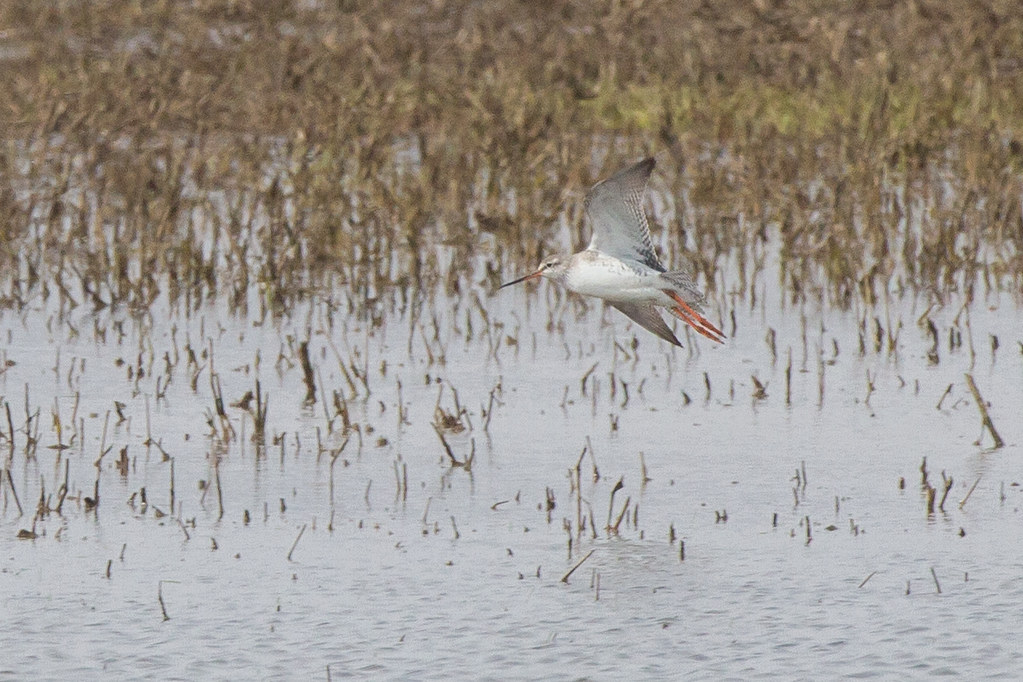
A Spotted Redshank, an ABA Code 4, appeared in Goose Pond Fish and Wildlife Area in southern Indiana recently, and conveniently ended many of our wintertime birding blues. Tens of birders have gone to the chase, with people from at least 5 states appearing almost as suddenly as the bird itself to add it to their life lists, their overall experience with birds, and maybe even just for the thrill of the chase. The bird is stunningly rare, and its appearance in the center of the continent is mind-blowing to say the least, but something else mirrors my amazement with the bird: its first appearance was two days ago, and yet birders from around the entire east are already gravitating towards this bird. This bird, while providing too an example of the wonders of wandering shorebirds, provides an example of the effect the information revolution has had on even the outdoorsy and nature-oriented pursuit that is birding.

The curtain opens at 9:30 AM on Thursday, March 28th. The Indiana Birding listserv is enjoying the perks of the long-delayed springtime arrivals, and suddenly, a short and concise email about a Spotted Redshank at Goose Pond pops up nonchalantly, making followers of Indiana birding aware of Indiana's first mega-rarity of 2013. In less than an hour, a series of forwards, re-tweets  and shares bring the news across the east and probably further, and the web of information continues to grow. More people know about it with each hour, and by the end of the day, people are planning the chase for the next day or even that night. It's still Thursday  the sun has barely set, and a northern Illinois birder, for example, is preparing to drive halfway there that night, fruitlessly attempt to sleep in a motel, and drive down to it early Friday morning. I know that many of us can get lost in our various forms of technology and start to believe that this is normal, that this is expected, but taking a step back and looking at the greater scheme of things, this is truly miraculous.
A shot of the Spotted Redshank by Ryan Sanderson
http://www.flickr.com/photos/ryanjsanderson/8603462831/

What makes this even more mind-blowing is that we're talking about an activity that focuses exclusively on nature in the outdoors. With an activity like birding, one wouldn't immediately associate the use of today's technology to such sophistication with the pursuit, but with further investigation, one would realize that birding is made of an extremely, almost unbelievably, connected bunch of people. Birding, through the years, has developed a system of codes, etiquette, and language to be used with modern technology. Birders use a myriad of blogs, email listservs, Twitter, almost every function of Facebook, and leave traces almost everywhere they go on the internet. Through these media, birders' sightings and ideas make up one of the most publicly accessible, scientifically relevant, and under-appreciated conglomerates of information in existence, and yet it goes on unnoticed right under the noses of the media and the majority of the public. Amazing!
A Stream of Communication

It's this connectedness that made all the additions to the life lists and experience of a variety of birders possible, and that's pretty darn cool. It's one of the shining examples of the benefits of social media, and it does and doesn't surprise me that it doesn't attain more notice. Regardless, for those of you who can remember a time when the birding community was connected by a loose network of people who had each other's phone numbers, you can really appreciate the change social media has made. In this way, though social media is often blamed for disconnecting people from nature and the outside world (not without merit), it has also been instrumental in connecting people all over the country to nature, be it for the first time, or as an enhancement to one's previous experience. This is something I really appreciate, and I hope you all do too.

Just a few thoughts from out my way. Happy birding!

Tuesday, 5 March 2013

Where Do Birds Go During Blizzards?

Cold, barren, bird-less...
As plumes of snow stream down from the heavens and bury me indoors, I wonder again about the lives of avifauna around me. Why are forests so lifeless, so silent, when snowstorms come through? Why are prairies so desolate? Why are wetlands populated by nothing more than wind and snow? It certainly enhances the mystique of the blizzard, but in the end it comes down to the survival of creatures that don't have the propensity to shelter that we do.

Before we take pity on the birds, we must remember that millions of years of adaptation have morphed these creatures into a form wherein they are highly able to eek out a living in the winter. But what does this mean? In nature, any adaptation is always a compromise, a balance, between the new and the old, as the new develops from the old. For most songbirds, the old behavior is to cover larger areas in search of every morsel of food in every nook and cranny to reap the greatest benefits from their territory. For example, Baltimore Oriole pairs maintain a territory around the size of a football field during the breeding season. While doing this, they must defend their territory from intruders and themselves from predators. But this old way of behavior must change entirely for the winter, and especially during a snowstorm.

Our first factor in winter survival is that food is far less evenly distributed, with some areas being supplied with super-abundant food, while others have no available food at all. With food sources fewer and farther in between, songbirds have to find these isolated food sources to supply their daily energy needs. This breaks down the  breeding season concept of territory. Now that resident songbirds no longer have to defend territory containing nests, they can roam more freely in search of reliable food sources. Once they find them, the bird is more likely to stay there because constantly searching for food requires much more energy in the cold, which is the second factor in adapting to survival in the winter. With more energy used to stay warm, it makes more sense to stop wandering and stay put in areas that will reliably provide food for a sustained period of time, e.g. feeders or large areas packed fruiting plants. That's where the initial adaptation is.

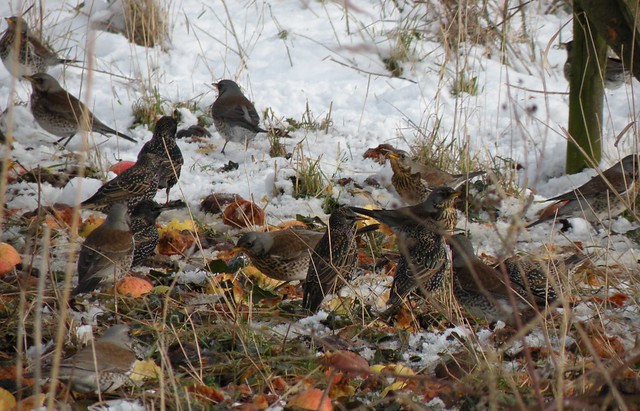
European winter feeding flock
http://www.flickr.com/photos/remarkable-trees/6858760461/
This all results in a more social element in winter songbirds. So whereas you will find birds like American Robins, Red-winged Blackbirds, American Goldfinches, and various sparrows to be isolated in the breeding season, when snow comes through, you find them in sometimes unbelievably huge roosts and feeding flocks. Birds that were once evenly distributed around given areas like their food sources are forced to cluster unevenly around their unevenly clustered food sources.  Remember too that flocks, though often forming simply because more birds have to pack around reliable food sources, also allow birds to use less energy searching for predators and more energy collecting food. This reconciles even more for energy lost remaining warm. In the winter, it becomes an advantage to be social at these isolated food sources, where other songbirds are invariably going to group. This is the initial adaptation--staying put around isolated and reliable food sources--taken to the next level; I'll call it the "resulting adaptation": social behavior. I like thinking of it as an equation, or better yet a conditional statement: If cold weather + isolated food sources -> birds stay put at food sources. If more birds stay put stay put at food sources -> social behavior develops. If you're still following, ultimately, this would mean that cold weather + isolated food sources = larger, social feeding flocks. Cool!!

The breeding season could be said to tear birds apart, and then the challenge of surviving winter, especially snowstorms, brings them back together. It would be accurate to summarize this process by saying that once the territorial boundaries of breeding songbirds break down, and food sources become more difficult to find, songbirds adapt their behavior to cluster together in social feeding flocks, and remain tight around food rich areas. That's all it is: an adaptation of behavior to survive in the winter.

With more birds clustered tightly in specific areas, this leaves greater areas of perfectly desirable habitat, well, bird-less because they lack reliable food sources. And voila!! The perfect recipe for making it seem like resident songbirds "disappear" in a snowstorm, and the winter overall.

Winter is a perfect time to see this strategy in survival--how staying alive requires an exact formula that results from millions of years of adaptation in similar conditions. That's not to say that songbirds are never found alone in the winter, because they are. That's not to that songbirds don't die in the winter, because they do, but the majority survive in an average winter, and there's a reason for that.

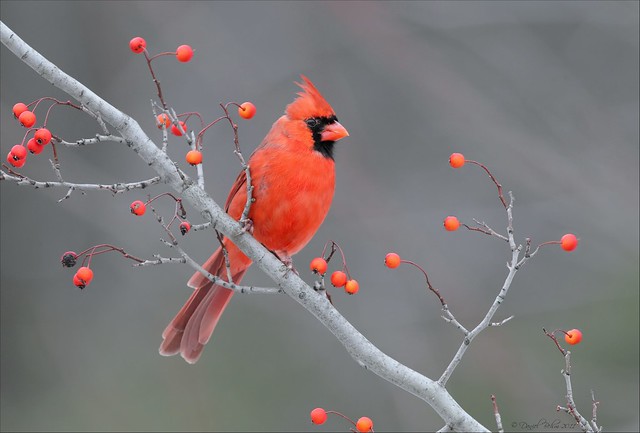
Stunning winter Cardinal by Daniel Behm
http://www.flickr.com/photos/30604643@N03/6535533013/
So as you're watching sadly as a cloud of snow descends upon your neighborhood, dreaming nostalgically of the Cardinal that sang outside your window just yesterday (birding blues), know that to find him, and many others like him, all you have to do is find the food sources. And with these food sources, you will find so many birds, and maybe a few rare ones too!

Saturday, 5 January 2013

A Thought-trip to a Fading Paradise

Remember back to the cool and humid days of spring, when all areas were bursting with lush, green life and blazing new colors. When life was exploding at the seams and taking on all forms and sounds. Let's forget the CBC's, Gull-watching, and face-numbing lake scanning of this season for a while, and think back to the little bundles of energy that we call the neotropical migrants. This time of year, they often become an out-of-sight, out-of-mind-type situation. We simply forget about them in place of gulls, finches, ducks and owls. But never fear, they are definitely still in existence. They are far south, deliberating territories and mingling with tropical residents that many of us have never heard of.

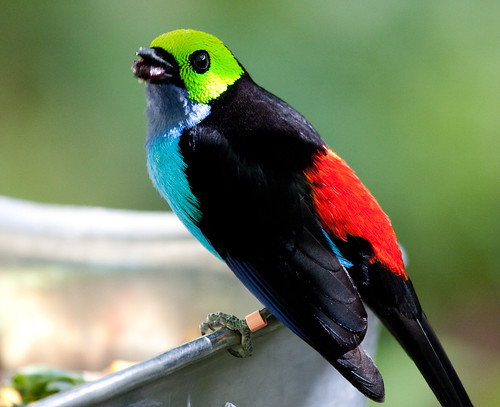
Paradise Tanager by Nathan Rupert
Let us descend on a hot and humid forest, shining with green just after a short rain shower. Alien sounds are blasting out of the forest. We hear the unearthly song of the Screaming Piha, the movie sound-effect calls of the Crested Oropendola, and the buzzy call notes of the rainbow of Tanagers (e.g. Paradise Tanager to the right) within an endless series of feeding flocks and leks. The forest is adorned with a huge variety of birds. But these birds are not our focus. Not the singing, nor the dancing, nor the displaying. We must focus on the inconspicuous, tiny passerines whose only vocalizations are nonbreeding call notes. In the middle of a pleasant morning's birding in the midst of this assortment, we realize that these birds are fighting for their lives against each other and their environment; one that is rapidly changing behind their backs.

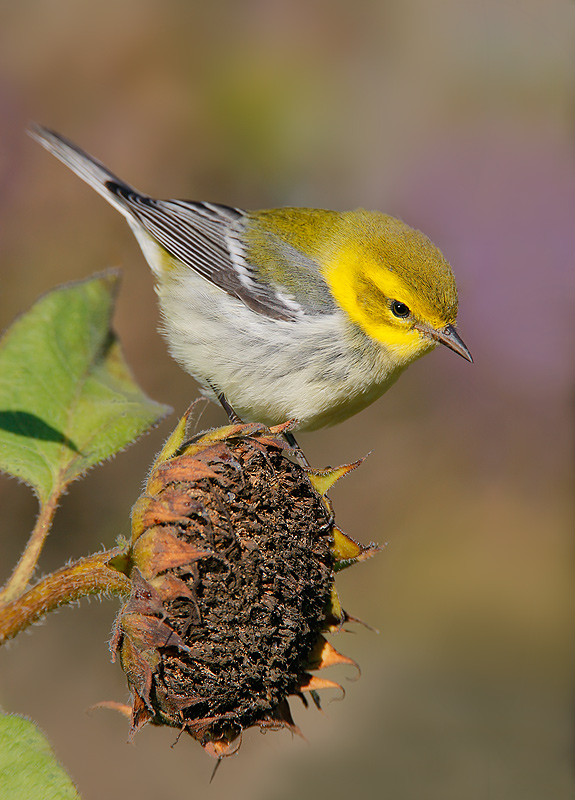
 Young female Black-throated Green
Warbler by Arthur Morris

The battle begins in the late summer, thousands of miles back in the North American boreal forest, when a hormonal shift causes the birds to feed frantically on anything they can find, and fatten up. After exponential growth in body weight, the bird, we'll say a young female Black-throated Green Warbler, gets the jitters, and when the right weather presents the opportunity, she instinctively rides the winds off to south (a miracle in itself). By September, she's survived the leap-frogging across patches of green over hundreds of American miles, and the long-haul, non-stop, over the Gulf of Mexico that make up her migration, and has made it to a decent forest stand in Central America. She is finally able to begin making a living in her first nonbreeding season.

Even before humans were around, first-year female songbirds did not have forest ecology in their favor. They are at the bottom of the passerine social hierarchy; in addition to competition between species for resources like food and territory, our female must compete with aggressive adult males, cunning adult females, and other youngsters as desperate and inexperienced as herself. As a result of this hierarchy, she ends up with some of the lowest quality forest available, pushed all the way to the dry and nutrient-deficient forest edge, a landscape quite alien to her. With the addition of human life, what was once a sprawl of rainforest that provided plenty of remaining territory for her has been replaced with a sprawl of farmland and rural communities. With so much of the necessary nonbreeding habitat destroyed, our female is now subject to new challenges to which she is not adapted. She experiences a sparsity of the food that would be easily found deeper in the jungle. Now in a more open area, she comes into contact with new predators in greater numbers, and is more vulnerable to them under the scattered cover. And possibly worst of all, she comes into contact with neurotoxic pesticides. Many countries in Central and South America do not have the bans on dangerous pesticides that we do in the United States. Organochlorides and other neurotoxins used to defend crops from insect infestation have wiped out unbelievable numbers of flocking migrants such as Swainson's Hawks and Dickcissels. Our young female, five inches long at .3 ounces, barely stands a chance. Even if she isn't taken by them, pesticides often disrupt migrants' navigational senses. More vagrants for birders, but not good news for birds.

Facing malnourishment, predation, and neurotoxic pesticides, young passerines especially face an enormous problem in their wintering grounds. Many of their original high quality wintering grounds no longer exist, so more birds from the North American breeding population must make due with the smaller amount of high quality habitat; it's no wonder that more and more of the population is being pushed to the margins of their habitat. In some highly fragmented places, only the strongest adult males are getting the highest quality habitat. This puts a worrysome percentage of the breeding population in quite a precarious position. It's no wonder that it's becoming increasingly difficult to find Acadian Flycatchers, Wood Thrushes, and Cerulean Warblers!

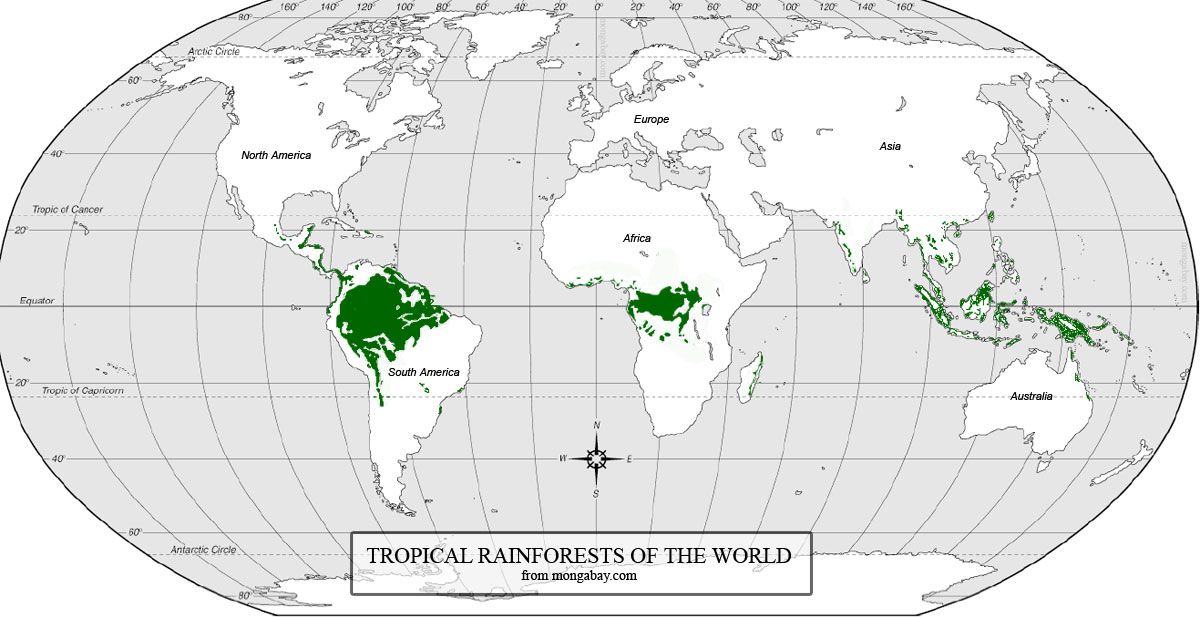
Tropical Rainforests of the world. Rainforests
yield the most biodiversity, but there are certainly
other biomes that house neotropical migrants.
But all is not lost...or at least not yet. The efforts of scientists are providing us with the information we need to properly conserve our beloved neotropical migrants, and the message is starkly clear: neotropical migrants absolutely need large areas of untouched, high quality forest to survive. No buts. There still are some sufficient areas, and luckily not all young passerines will experience what our hypothetical female has, but to preserve these areas, action is needed immediately. After all, once a rainforest is gone, nutrients are gone with it, and aridlands take their place, making it extremely difficult to reestablish the forest. Fully shade-grown coffee industries and the efforts of numerous conservation organizations are crucial to the cause of the neotropical migrant, but as always more is needed. The long-term, gradual decline in the population even when we have made a great effort in the States to preserve their breeding habitat has shown that Houston, we have a problem, and specifically one outside of the North American Continent. It is not a comforting message.

So the next time you see a neotropical migrant, say, a young female Black-throated Green Warbler, think of the grand cycle and natural drama it has participated in. Think of the tens of thousands of miles it has flown, and all of the challenges it has faced. Think of how lucky that individual is to be living. It is sometimes said that 40% of the North American breeding songbird population has been lost since the 50's, with some species' populations nose-diving a frightening 80%. With the obstacles many young birds face in the tropics, it really is amazing that populations keep chugging along. So all I ask is not to take them for granted. We are blessed with the avifauna of our time, and it's a travesty to think that they may not exist for future generations.

Overall, the best we can do is to keep learning. Any observations of the birds are scientifically relevant; the more we know about them, the better we can protect them. So after we've endured the painful yet rewarding time that is winter birding and spring comes around, be sure to get out there and find some warblers! But then again, I don't have to tell you to do that, do I?
To read more about this subject, I highly recommend Bridget Stutchbury's Silence of the Songbirds, as one blog post can only touch the tip of this iceberg. Her narrative ability makes the book a joy to read, and brings the reader to an incredibly intimate understanding of these neotropical migrants.