Sunday, 16 December 2012

How to protect your kids from brood parasites: Talk to them!

Let's do some science, shall we?

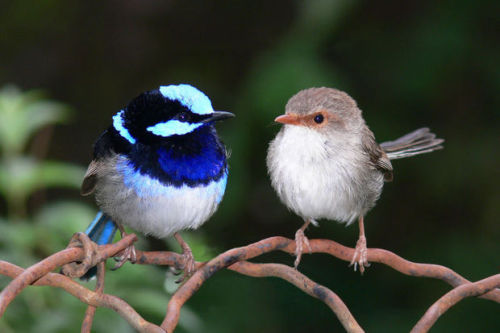
Lots of birds have problems with brood parasites, such as the cowbirds of the new world and cuckoos of the old world. Most brood parasites have adapted a faster incubation period and a faster growth period, so that they can hatch before the parasitized bird's actual eggs and either push them out of the nest, or just take all the food so the other chicks starve. However they do it, there are various solutions that birds have adapted to avoid this problem. Some kill the parasite's egg, some abandon their nest, but by far one of the most unique solutions are that of the Fairy-wrens, a fascinating group of songbirds native to Australia that could be described as chickadees plus hummingbird-level color.
Internet photo of Superb Fairy-wrens, male and female

A recent study has revealed that fairy-wren mothers begin communicating with their offspring before they have even hatched. During incubation, female Fairy-wrens give a sort of incubation call that, when the chicks hatch, will become a vocal password for food. Without this vocal password, the chicks will not be fed. She gives this call repetitively late in her offspring's incubation period, and is embedded in their brains when they hatch. This vocal password, then, is their begging call and is unique to each nest, so mothers always know which chicks are actually theirs, or at least which chicks they incubated. Mothers use these

Let's go through this:
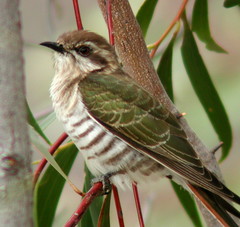
internet photo of a Horsfield's Bronze-cuckoo
The female lays and and begins incubating her eggs. The eggs typically take about 15 days to hatch, so the female waits until day 10 to start giving her incubation calls, both so that her embryonic offspring can actually hear her, and so that she doesn't spend the entire incubation period giving her nest away to predators. Timing is where the tables are turned for the early hatching bronze-cuckoos' (see left) chicks that frequently parasitize fairy-wrens' broods: bronze-cuckoos hatch after 12 days rather than 15, so they don't get nearly as much time within the egg to learn the vocal password. Without the correct vocal password, the fairy-wren parents will not feed the chick, so the brood parasite never gets fed, while the actual fairy-wren chicks, hatching three days later with the correct begging calls, are given all the food. Case closed, end of story. Suddenly, the early hatching habits of the bronze-cuckoo that were once an adaptation become a HUGE disadvantage. Cool stuff, right?

This discovery leads to a few questions, too. First off, if Fairy-wrens learn their begging calls during incubation, do they have any begging calls genetically programmed? The answer, it turns out, is no; Fairy-wren chicks develop with a blank slate, and learn everything in the egg. The significant implication here is well put by one of the researchers:

     "These findings demonstrate that traits that appear to be innate, such as nestling begging calls, may actually be learned. Knowing this adds to our understanding of evolution and also has many practical implications, particularly for captive breeding and conservation biology."

This also means that if a mother's actual offspring are replaced by unrelated offspring during incubation, the mother's actual offspring will not know the correct call to be fed by their actual mother. It all depends on learning the right call. Another obvious question: how do males learn the calls? They don't participate at all in the incubation, but they still know the vocal password, so the female must communicate it in some way. The researchers in Australia had similar questions, and they found that females share the vocal password with their mates through a so-called "solicitation song". This way, there are no loop-holes in the vocal password system. Finally, we'll end with a prediction in the next step in what has now become an "acoustic arms race" between brood parasite and Fairy-wren: in order to survive, Bronze-cuckoos will have to adapt to their smaller window for learning the vocal password, by, well, learning it faster.

Whatever the cuckoo's "counter-solution", it seems the relationship between parasite and parasitized always produces fascinating discoveries. The big question now is if any species here in North America have adapted a similar system. The encroachment of farmland onto what were once eastern woodlands safe from brood parasitism has brought birds like Red-eyed Vireos, a species completely without adaptation against brood parasitism, face to face with Brown-headed Cowbirds, who like open areas more than forests. It will be interesting to see where evolution takes this conflict, and this discovery on these diminutive, color-blasted Australian songbirds gives us new insight into this process.

Have a great day, everyone.

Saturday, 1 December 2012

Nutting's Flycatcher: a Big Year Birder's Dream

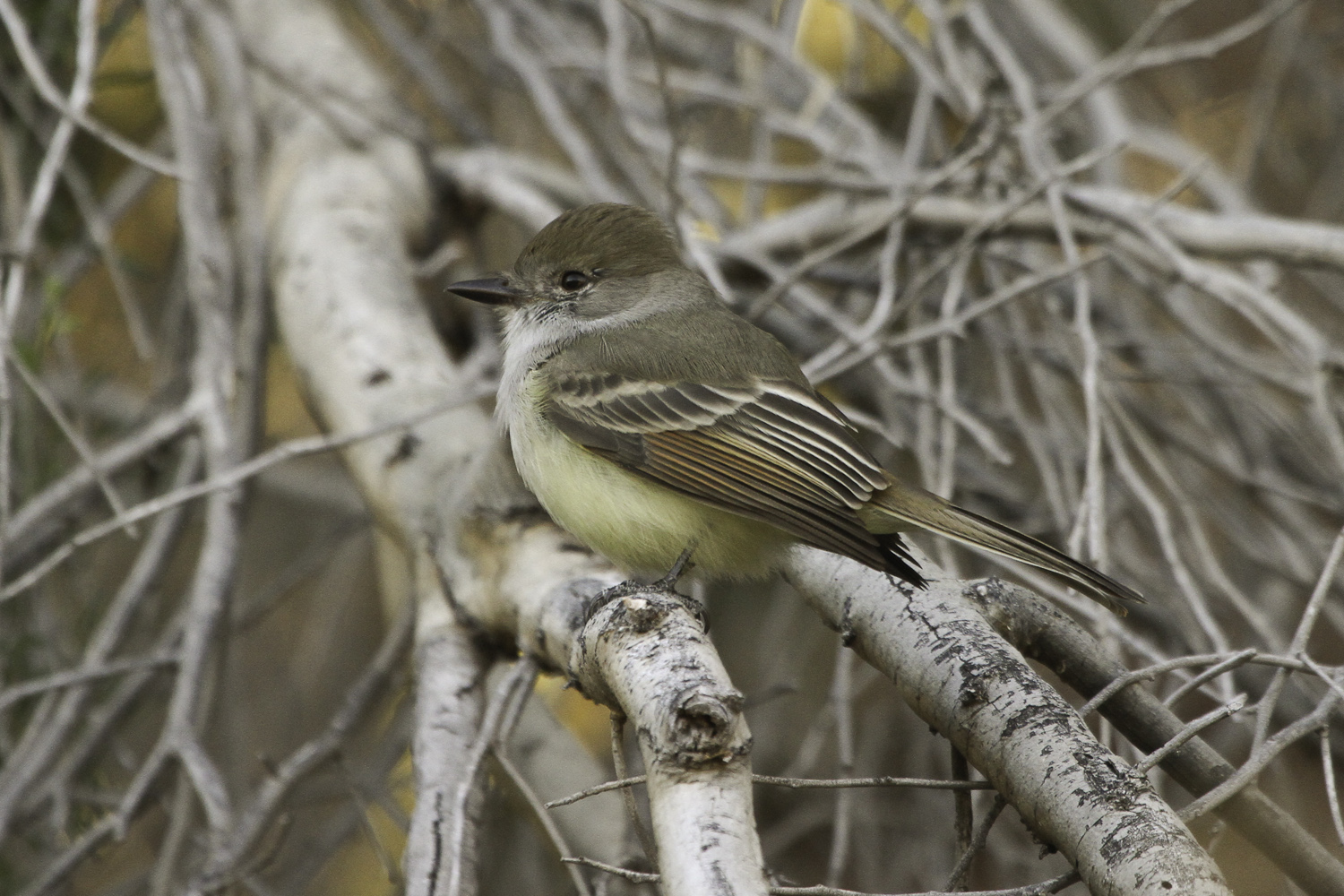
A Nutting's Flycatcher--Myiarchus nuttingi--recently made an appearance in the desert oasis of Bill Williams National Wildlife Refuge for the second time this year. This makes Arizona a pretty lucky state: Nutting's Flycatcher is a Code 5 (a.k.a. accidental) species in the ABA Area, meaning that the species has been recorded five or fewer times in the North American continent, and yet it has been recorded twice in the same spot in the same year! It even seems to have overwintered in this wildlife refuge, as it was first found in December of 2011, and was last found March 25th, this year. Basically, it's one of those really rare birds that make ANY Big Year that much better, including Sandy Komito's record setting Big Year of 1998 after which both the book and the movie titled "The Big Year" are based. Nutting's Flycatcher was the first rarity that Komito started with. Image that. January 1st; you start your year with a Code 5. That's good birding man.

But beyond the birding aspect of it, let's look into the biological aspects of this sighting. We'll start with a perennial birding favorite: the range map.
From this fine map--found on Cornell's Neotropical Birds--we can see that Nutting's Flycatchers are not migratory, but can infer that they probably disperse from their breeding territories when the season's brood is raised. We can also see that their range stretches up the western half of Mexico almost to Arizona, so it's not much of a stretch, one would think, for Nutting's Flycatchers to occur in Arizona. Their nonmigratory habits would account for their Code 5 status, though, because the birds just don't move around enough to make them common outside of their range. So what would draw the bird (if it is the same individual) to this wildlife refuge twiceBill Williams National Wildlife Refuge is described as a rare desert habitat with some of the last stands of native cottonwood-willow forest along the Colorado River. This creates a rich, even lush riparian habitat that would appear attractive to neotropical migrants, and even neotropical rarities. But why didn't the bird just stay where it was? Wouldn't the bird have plenty of habitat in its actual range? There's not an easy answer to these questions as we don't know much about this individual other than its occurrence north-of-range, but the answer may be yes. During the nonbreeding season, a hierarchy develops that dictates which songbirds get which qualities of habitats, with older adult males at the top, younger males and females just below, and young females at the bottom with the lowest quality habitat. As habitat destruction and degradation continues, this hierarchy is pressured for all sorts of species, and the birds at the bottom are getting it worse and worse. This could push some of the individuals on the bottom of the scale out-of-range just to survive, so it would be interesting to see if this individual is a young female. We'll see how long this bird sticks around--we might get some experts on the job.

With every rarity, there are always tons of questions, even beyond identification. IDing Nutting's Flycatchers is a challenge in of itself; they even used to be considered the same species as the more common Ash-throated Flycatcher. Luckily, they give their distinctive callnotes frequently. But beyond that, why the bird is occurring out of range raises all sorts of questions, such as how it behaves differently when in and out of range. Sadly, the likelihood that most of these questions will be answered is slim, but that's one of the best things about birds, and nature as a whole: it puts you in a constant state of inquiry, and that's a big reason why I'll never stop.

To read more about the bird, check here and here.

Internet Photo of the Nutting's Flycatcher. Found here.


Friday, 30 November 2012

Your Friendly Neighborhood Conifer Stand

This fall and winter has been jam-packed with irruptions of almost every sought after bird for this time of year. We've had insurgences of Red-breasted Nuthatches, incursions of Crossbills of all types, and invasions of Evening and Pine Grosbeaks. Even Hoary Redpolls are in greater-than-average abundance.

Red Crossbill Sightings Since October. Orange pins are sightings from within 30 days of today (11/30)

Not only have the birds been in a frenzy, but birders have been flocking together and sharing some great information about the birds irrupting, like a post made on eBird about Red Crossbill types by one of America's foremost crossbill-type experts, Cornell's Matt Young. Whatever the reasons for the irruptions, birders are maintaining a steady stream of sightings to keep one ever informed. Good starting places for the sightings are the American Birding Association's new Birding News site, which is a compilation of numerous birding listservs from every state and even out of the U.S. Another good starting place is eBird's Range Maps, which you can use to construct maps like the one I made above and to check recent sightings.

But once you've done this, the only thing left to do is to go out and FIND THE BIRDS, and to do this, you need your handy neighborhood conifer stand. This is where you'll find some of those gorgeous little rarities from the North. Some days, conifer stands can be bursting with avian life. Picture this: The sun is shining, with very little wind, and a chorus of bird vocalizations and wing-sounds chokes out even the sound of your footsteps. You're in heaven. Like in a gorgeous winter version of the ebullience of picking through a flock of Springtime warblers, you sift through the flock in your lenses, seeing colors of blue, pale green, yellow, brown, pulsing along the rippling, ever-present deep-green consistency of their evergreen backdrop. It's beautiful. Forgetting the addition of whatever species to whatever list, you stand in awe of the exceptional event that is occurring around you: the convergence of the annual cycles of emblematic arctic animations--but no alliteration can capture the power of what's really happening. These little, feathered organisms have wandered in groups for thousands of years, and only here and there in these long-scale cycles, they all come together just because their very survival happens to depend on it. You are there for one of them, and might never witness it again. These are the kinds of blessings that birders, naturalists, and scientists alike crave for; they foster learning, curiosity, and a connection with the living world around you. It really doesn't get much better than that, folks.

My friendly neighborhood conifer stand
But today was not that day for me. It's true that all places can be alive with birdlife, or totally "dead", as we birders like to put it, but for some reason, conifer stands seem the more dead than anywhere else when they don't harbor any avifauna. I think it's the oppressive (or sometimes relieving) silence they force that only the wind manages to defy here and there. When you come upon a conifer stand that's totally devoid of life other than the statue-like trees themselves, it makes one feel like life will never return again. But persist, my friend. The birds will return. Enthusiasts have been finding Pine Grosbeaks, Red Crossbills, and White-winged Crossbills in their neighborhood conifer stands with both frequency and consistency, so you never know which boreal nomads you'll come across.


Remember, it just takes getting out there to discover something!

Friday, 16 November 2012

Recent Videos on Birds and Birding

Hey Everybody!

It's been a while since I've posted, but I have a lot in the works. I'll be posting on things like pigmentation in birds and how global climate change is spreading malaria to places where it's never been before. I might even post a little more about birds and weather...you'll just have to wait and see! For now though, there have been two fantastic videos about birds or birding that have come out recently, so I thought I'd embed and share them here. Check it out!


A Passion for Birds from The Field Museum on Vimeo.

An awesome video made by the Field Museum on Vimeo featuring such respected birders as naturalist Kenn Kaufman, the author of his own Field Guide series, his wife Kimberly, director of the Black Swamp Bird Observatory, John Fitzpatrick, director of the Cornell Lab of Ornithology (and the scientist after which a recently discovered new species, Sira Barbet--Capito fitzpatricki--is named after), Shannon Hacket curator of the Bird Division at the Field Museum, and more. It's a video explaining a passion for birds that links together all of them.


Watch An Original DUCKumentary on PBS. See more from Nature.

A recent PBS Nature documentary all about ducks. It contains some amazing footage and behavioral notes about this fascinating and ancient group of animals.

Thursday, 13 September 2012

9/11 - A view into bird migration

On the solemn day of 9/11, the Tribute of Light lit up the New York sky in memoriam. As we all remembered that faithful day in 2001, one man, Cornell Ornitholigist Andrew Farnsworth, planned for a night of birdwatching...in art from the roof of the Empire State Building. Farnsworth saw a great ornithological opportunity in these lights of remembrance: this time of the year, the Northeast experiences enormous bird migration almost every night, and from atop the skyscraper, Farnsworth could count each bird that flew through the columns of light, and, in so doing, get an accurate picture of which birds were migrating over.

The Tribute of Light. Photocredit Greg Chow
Farnsworth has a special interest in night-migrating birds. He is an associate in one of the Cornell Lab of Ornithology's ground-braking projects: BirdCast. BirdCast is a service that brings live migration forecasts based on knowledge of how migration is affected by weather, and also by eBird reports, radar analysis, and Farnsworth's specialty, acoustic data. The clear night of the 11th along with the revealing lights of the Tribute provided the perfect opportunity to take in data and build on our knowledge.

And reveal they did! From early in the eventing to 10pm, Farnsworth birded from atop the Empire state building, and from 10 on until past midnight, he birded directly from the Tribute lights. It is reported that he saw more than 2, 000 birds and heard the faint flight calls of many more. From warblers to thrushes to grosbeaks and tanagers, Farsworth got them all. The massive bird movement even brought in some herons, rails, and a Peregrine that picked off some disoriented songbirds from within the lights--as the expression goes, like taking candy from a baby. See his full list here.

Here I've attached a recording of one of the most distinctive flight calls, one that you can listen for from your own backyards at night: the Swainson's Thrush. Listen for the roundly sounded spring peeper-like call during the day to--these birds are all over the place if you listen.

There are two things that are revealed by this story. The first is obviously the sheer enormity of the bird movement at night, when we aren't even aware of it. But slowly, the science of birds is putting together the pieces. In the 50's (I think) radar operators began seeing things like this:
Around this time, somebody realized that all that blue is BIRDS (for more about birds and radar, see my earlier post about it or visit woodcreeper.com). As time went on, acoustic data from night flight calls were added to the pool of knowledge, but we're still learning. Night migration is still shrouded in mystery. It's stories like this that show how even in the biggest city in the country, windows into this greatest of natural phenomena are there, and all we have to do...is...well...get on top of the Empire State Building and shoot giant beams of light into the sky. Okay, maybe not all that practical, but what matters is being aware of the processes at play around you, and all that we can learn from them.

The second thing is just that sort of learning. Have you wondered why it was so easy to pick out tiny birds in the giant light beams? Birds just darting through wouldn't give much a chance for identification. The problem is, migrating birds use stars for orienteering purposes, and lights from buildings--or in this case memorials--can be highly disorienting. Many of the birds became disoriented and circled around and within the light, and hovered in place in confusion. This is why that peregrine (see list) had such an easy meal. This is why cities with tall, well-lit skyscrapers can be deathtraps for birds. There's even a hotline in Chicago (and most cities) for dead and stunned birds from collisions with buildings. So what's the solution? Turn off the lights! And luckily, just that was done with the light beams after 12:30 am or so the night after 9/11/12, allowing many of the birds to reorient and continue their migration.

As time goes on, events like these increase our understanding of bird migration, and the more we know, the more we can do to protect it, one of the most important and powerful processes in nature.

Click here to see the first post about this event on the Cornell Lab blog.

Saturday, 8 September 2012

Midair Feeding Strata?

One of the great things about birding in the forest is how easy it is to pick out each bird's ecological niche. For example, on the bottom, you have Ovenbirds and Thrushes, in the middle you have all sorts of warblers, tanagers, flycatchers, tree-clinging birds, etc., and on top you have vireos and certain other flycatchers. And this is just Eastern Woodland birds. All forests have developed these "feeding strata", or levels wherein different kinds of organisms feed on the different food items that are found there. These strata are unique for every forest, and they show how forests evolve and develop relationships as a system, and when one cog in the master machine falls out, the machine can no longer function as a whole.

Another classic example of feeding strata is underwater, in coral reefs or elsewhere. Different fishes feed at different levels. But what about in midair? We all know and love swallows, swifts, and other aerialists whose energy and agility are an infinite source of free entertainment. Do they have different preferred levels at which they feed too? Most of the time, we see these so-called aerialists separately, some swallows at a pond, some swifts of a neighborhood, some nighthawks over a parking lot, etc. But when they come together, it becomes obvious that there are in fact feeding strat in the sky. One morning, not to long ago, a cloud of swallows--multiple species--had gathered over a local marsh. The swallows remained relatively close to the marsh without going more than say 50 feet above the cattails. Below them, in some taller shrubs and small trees, a flock of Cedar Waxwings was displaying their aerial abilities--something they're often not given credit for--by sallying out and then back to catch flying insects, but never in the level of the swallows. Up above the 50 feet of hirundinid madness, Chimney Swifts had gathered to feed on insects higher than the swallows would push for. So clearly some aerial strata have developed: waxwings on the bottom, swallows in the middle, and swifts on top. And what does this tell us? It tells us that each group of birds is adapted to hunting in different altitudes (their niches are different), and in doing this, they avoid direct competition between species.

 This just comes to show that even the littlest, seemingly insignificant observation can tell us a lot about nature, so get out there, keep your eyes and ears open, and who knows what discoveries you'll make!

To top this post off, here's an amazing video of Tree Swallows gathering for migration:

Thursday, 31 May 2012

The Hidden Complexity of Birdsong

Birdsong, and even calls, sometimes exhibits complexity that we humans cannot hear. Birds use these complex vocalizations to communicate a wide range of information, from breeding status to warnings.

One of the amazing examples that I recently came upon was a video (see below) by Lang Elliot, a bird photographer and videographer. The video is about the Henslow's Sparrow (Ammodramus henslowii), a small and reclusive species of grassland sparrow. The song of the Henslow's Sparrow, to us, sounds simple and boring, a "tsidlick", as its song is often described. Roger Tory Peterson, the inventor of the field guide, called it one of the poorest vocal efforts of any bird. But to the sparrows, their song is certainly not simple. At 0:57, Elliot slowed down the song to show its hidden complexity, turning it from "tsidlick" to what I paraphrase to a "deet-dew-dewdew-deet-dew!" The song turns out to be a series of well-defined notes pushed together into a short period of time; one has to wonder if the sparrows can hear and discern each note of the song jumble better than we can. One also has to wonder if the ancestors of the Henslow's Sparrow's had a song that wasn't so jumbled, so that a human really could hear each individual note. Once again, we find a behavior shrouded in mystery...